
Overview
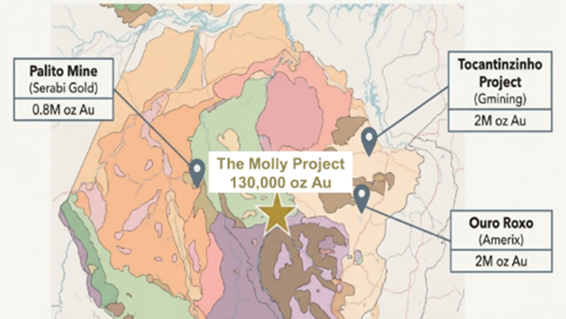 The 6,656.2-hectare Molly Gold Project is located in the Tapajós Gold Province of Pará State, northern Brazil, a globally recognised district hosting several multi-million-ounce deposits, including São Jorge, Castelo dos Sonhos, Palito and Tocantinzinho. With estimated historical alluvial production of up to 30 million ounces, the province remains highly prospective yet underexplored for large-scale hard-rock gold systems.
Molly sits within a proven corridor of hard-rock gold mineralisation. The primary focus, Molly 1, hosts an east–west striking quartz vein system, 0.5m to 3m wide, which was historically mined by artisanal operators to depths of around 30 metres.
A 2,857m, 19-hole diamond drilling programme tested down-dip extensions beneath historical workings and confirmed a robust, near-surface epithermal gold system. Significant intercepts included 3.0m at 14.4g/t Au, 5.07m at 8.6g/t Au, 6.5m at 10.5g/t Au and 1.0m at 200g/t Au. Mineralisation extends from surface to approximately 150 metres depth over a 400-metre strike and remains open at depth and to the west.
A JORC-compliant Inferred Mineral Resource of approximately 130,000 ounces of gold (0.5g/t Au cut-off) has been defined. Geophysics indicates the current resource represents only part of a broader mineralised corridor extending more than 500 metres westward, highlighting strong expansion potential.
Phase 1 will focus on western step-out and resource upgrade drilling, while Phase 2 aims to assess a potential multi-pit development, including work at Molly 2, metallurgical testing and preliminary economic studies. The Company is fully funded for both phases.