
Overview
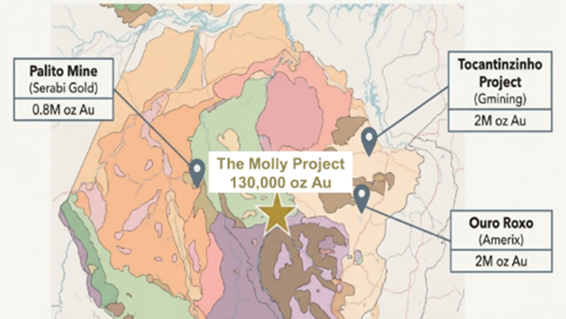 The 6,656.2-hectare Molly Gold Project is located in the Tapajós Gold Province of Pará State, northern Brazil, one of Brazil’s most prolific yet comparatively underexplored gold districts. The province has estimated historical alluvial production of up to 30Moz of gold and hosts several significant hard-rock deposits and operating mines, including Tocantinzinho, Palito, São Jorge and Castelo dos Sonhos. Molly sits within this established gold belt and already hosts a JORC-compliant Inferred Mineral Resource of approximately 130,000oz Au at 2.0g/t at Molly 1. The deposit comprises high-grade, near-surface quartz-vein systems and a lower grade minrealised structures making it conducive to open pit production. Historical drilling, which has been validated, returned standout intersections including 3.0m at 14.4g/t Au, 6.5m at 10.5g/t Au and 1.0m at 200g/t Au, with geophysics indicating the mineralised structure continues at least another 500m west of the existing drilling. The broader Tapajós district is attracting increasing investment, with G Mining Ventures, Serabi Gold, GoldMining Inc., Cabral Gold and TriStar Gold advancing producing or development-stage assets across the province, providing important geological and infrastructure validation for Molly.
Jangada’s exploration activity is increasingly demonstrating that Molly could extend well beyond the existing Molly 1 resource. Recent drilling has validated the historical geological model, extended the mineralised envelope and returned results including 21.81g/t Au over 0.5m, 20.76g/t Au over 0.5m and 14.15m at 1.19g/t Au, while Molly 2 has been confirmed as a separate discovery that remains open towards Vivi. Particularly encouraging is Vivi, where surface sampling has identified exceptionally high-grade gold-bearing veins, adding another potentially important mineralised centre to the western extension of the system. Further upside comes from the multi-kilometre Boomerang target, north of Molly 1, where extensive historical artisanal workings across a large area could indicate a significant underlying hard-rock gold source. Jangada is using drone magnetics, IP geophysics and follow-up drilling to test these targets and better define the structural controls on mineralisation. Collectively, Molly 1, Molly 2, Vivi and Boomerang support the potential for Molly to develop from a relatively modest existing resource into a much larger, district-scale gold-polymetallic system.