
Geology & Mineralisation
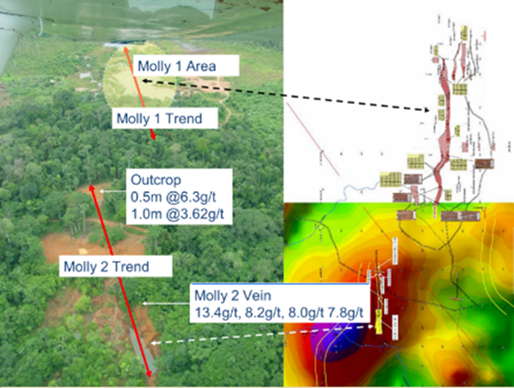
Molly lies within a proven corridor of hard-rock gold mineralisation that demonstrates the district’s capacity to host large, economically viable deposits. The primary target is Molly 1, where high-grade quartz veins were historically mined by garimpeiros to depths of up to 30 metres. Mineralisation is hosted within Paleoproterozoic Parauari granites, a recognised host for major gold deposits in the Tapajós Province, and is shear-hosted within a multiple-lode epithermal system. Gold is associated with quartz veining containing sulphides including pyrite, galena and chalcopyrite. A dominant east–west striking quartz vein, ranging from 0.5 to 3 metres in width, forms the high-grade core of the system and is surrounded by a classic epithermal alteration halo characterised by potassic, phyllic and argillic assemblages, significantly expanding the overall exploration target. Historically, drilling has focused on testing the down-dip extensions of these high-grade vein systems beneath the artisanal workings.
 |
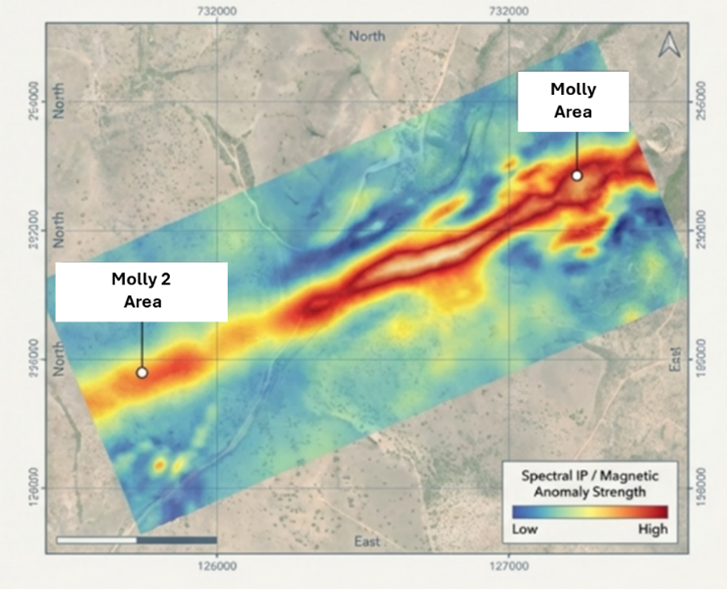 |
Ground-based spectral induced polarisation (IP) and magnetic surveys have revealed a strong structural trend linking the Molly 1 prospect with the Molly 2 area to the west. Interpretation of these geophysical anomalies suggests that both areas form part of the same mineralised system, offset by later faulting. This significantly increases the size of the exploration target and supports a district-scale geological model.
Mapping and geophysics indicate that the mineralised structure continues for at least 500m west of the current drilling, beyond the defined 400m resource strike length. This untested extension has the potential to more than double the strike extent of known mineralisation, representing a major opportunity for resource growth.